How To Improve Functional Strength and Balance
Keep expanding your knowledge and actively build your body’s strength and balance. This article provides thorough explanations to boost your understanding, along with specific corrective exercises and straightforward directives that support improving core and leg strength for better balance. By practicing these methods, you will become more confident and efficient with essential movements such as standing, reaching, lifting, bending, rolling, and rising from the floor.
Lower Body Strength & Endurance – Timed 30 Second Sit to Stands
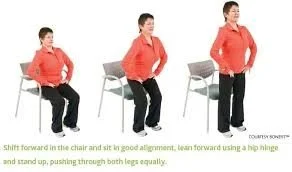
If you experience shoulder pain or discomfort, consider how often you use your arms to stand up from a seated position. Many sedentary adults report shoulder problems that actually stem from relying too heavily on their arms when pushing or pulling themselves upright. When the legs and core are weak, the upper body is forced to compensate, placing unnecessary strain on the shoulders. This same pattern is often seen when using assistive devices like walkers: the increased pressure through the arms highlights underlying weakness in the legs and core.
To maintain or improve leg strength, your muscles need to be used regularly. Strength is not something we can take for granted. People are often surprised when routine tasks become challenging, even though they have made no effort to keep these abilities. For example, if you stop climbing stairs, your strength to climb them will eventually decline. Your body adapts to what you do most often. Spending long periods in a supportive seated position accelerates muscle loss in the core and legs, making it harder to stand, walk, and maintain balance.
This often leads to a vicious cycle I have seen repeatedly in my work with older adults. Fear of falling or the anticipation of pain leads to avoiding movement. But the less you move, the weaker and stiffer you become. Then, when you do need to move, it has become more painful and difficult, which increases your risk of falling even more.
A common scenario involves frail adults falling while trying to get to the bathroom. Many wait until the last moment because standing is such a struggle and often painful. Once they finally stand, they need to rush, increasing their chance of losing their balance and falling.
I have mixed feelings about electric lift chairs. On one hand, they can support independence by helping someone stand safely. On the other hand, heavy reliance on them means the legs and core are not doing the work, which accelerates muscle loss and reduces strength, balance, and mobility.
A simple way to stay strong:
Perform at least 10 sit-to-stand exercises each day from a stable chair placed against a wall. This single activity can help maintain your ability to rise independently and move safely within your home. If 10 repetitions feel too difficult at first, start with whatever number you can manage, even if that is only one. You can start by doing one to two sit to stands several times throughout the day, gradually increasing your repetitions to 10 or more consecutively as your strength improves.
Staying strong means staying independent.
Core strength
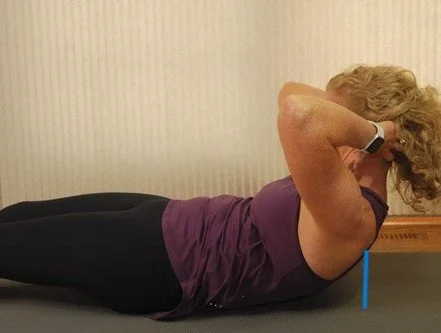
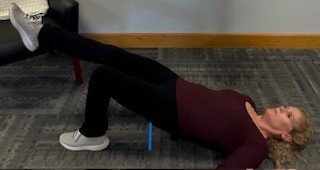
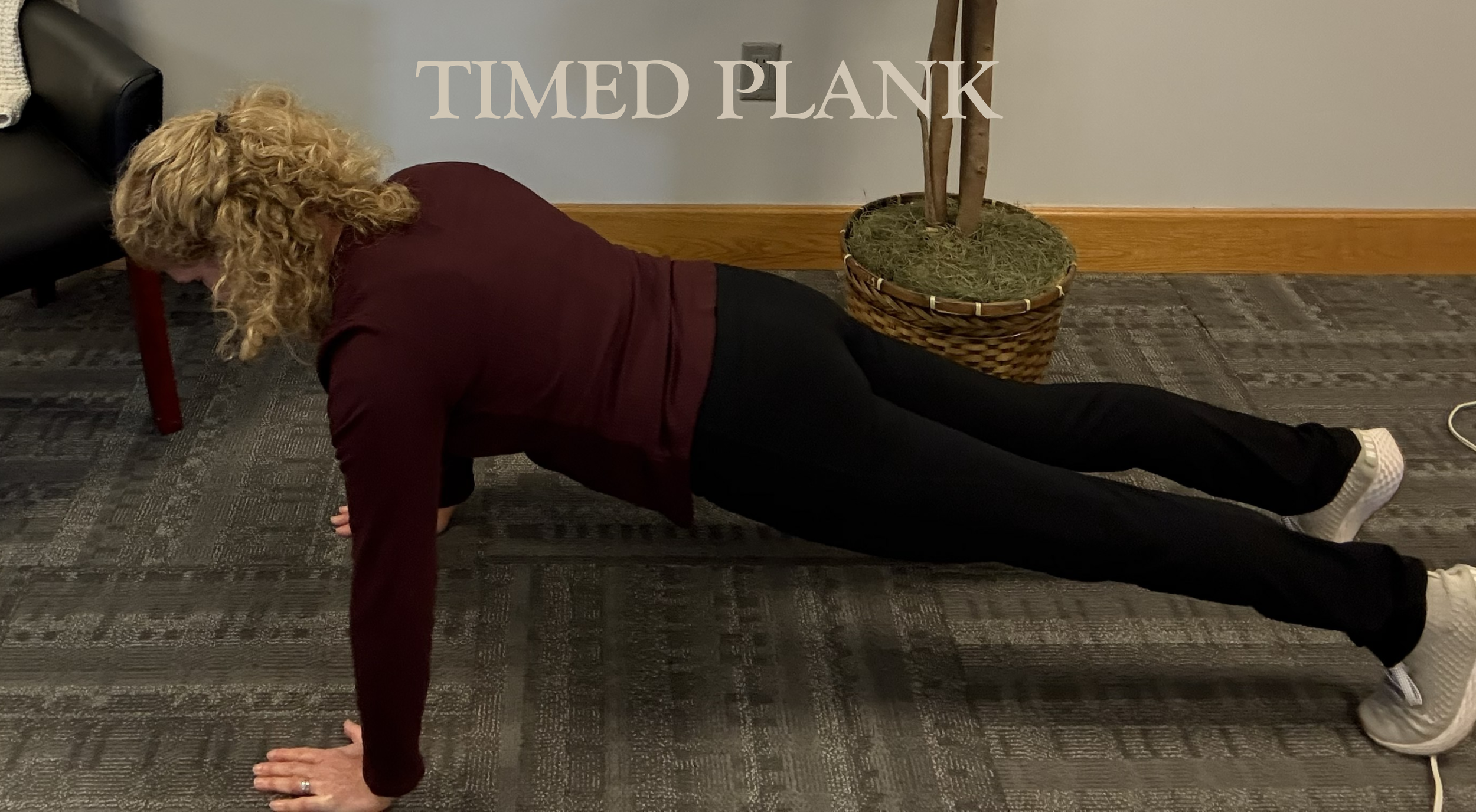
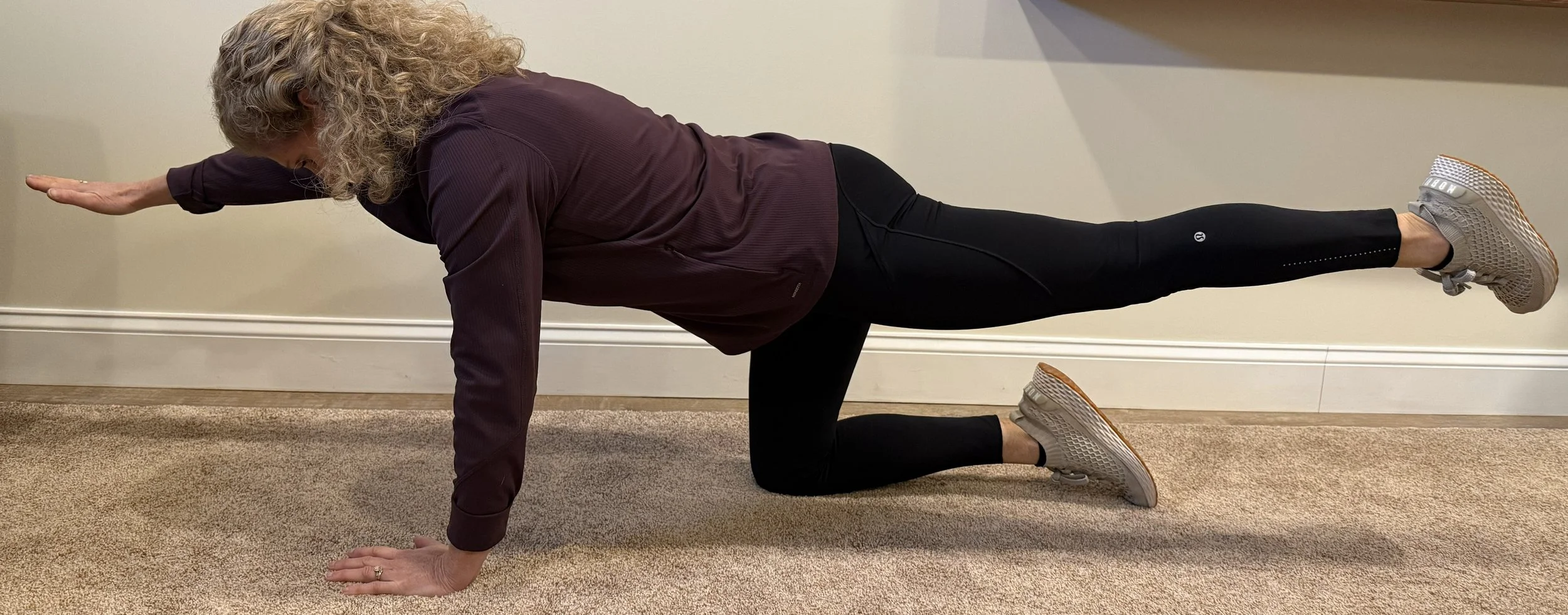
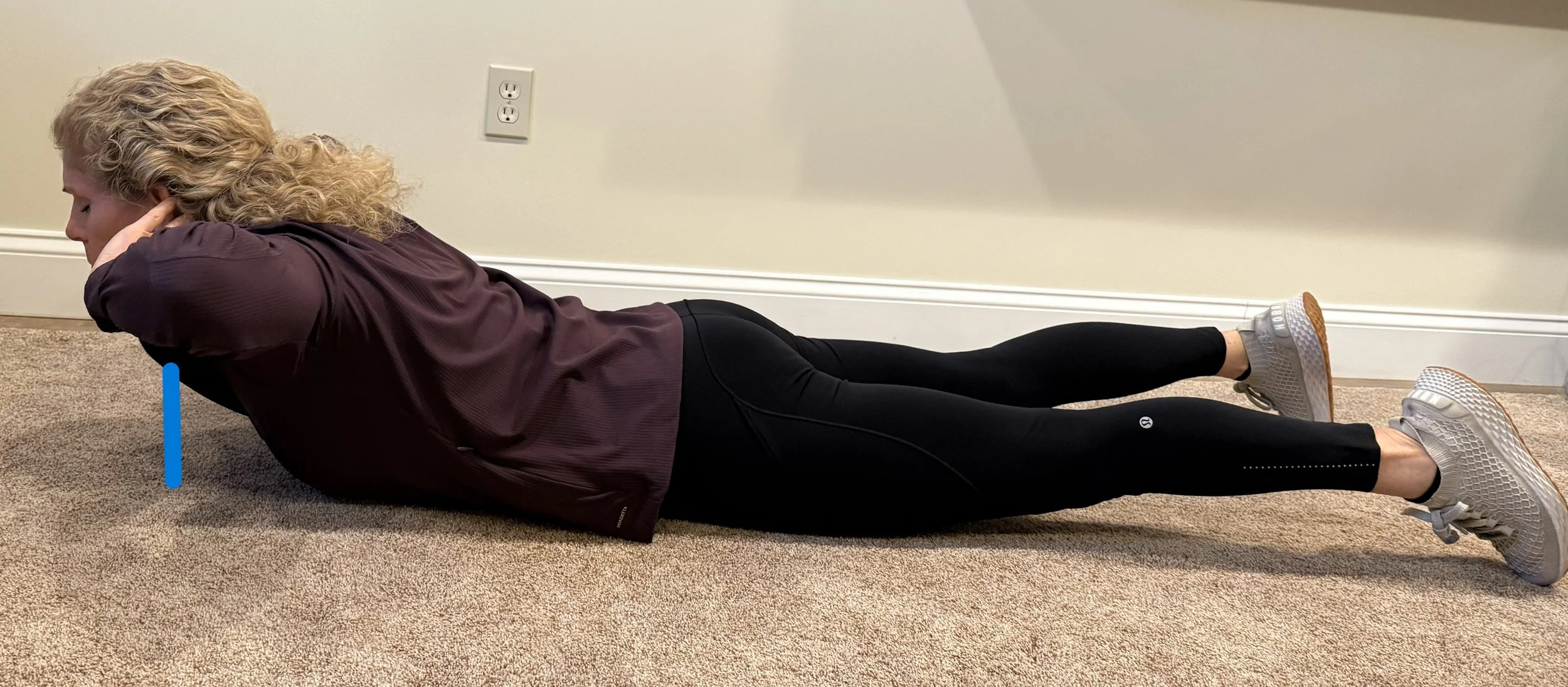
The Sit Up Hold, Single Leg Bridge, Timed Plank, Birddog, Back Extension Hold and Rolling assessments are intended to provide insight into the strength of your core. I recommend doing these assessments regularly as part of your exercise regimen, as they effectively engage and strengthen your core muscles.
A common mistake is focusing solely on the anterior abdominal muscles, commonly referred to as the “six pack.” The core comprises the deeper muscles underlying the abdominals, obliques, back, hips and glutes. They are also the muscles of your pelvic floor and of your diaphragm. Be careful with the sit-up hold, do not turn this assessment into a repetitive sit-up or crunch as this exercise places a lot of stress on your spine, both at the neck and back.
Sit Up Hold
Lie on your back with your hands behind your head, (Modified - arms crossed in front of your chest) lift your head, shoulders and arms off the floor, to a height that your shoulder blades no longer touch the floor. Hold for time.
Single Leg Bridge
Single Leg Bridge - Lie on your back with your legs hip width apart and knees bent, feet flat on the floor. Push through your heels to raise your buttock off the floor and hold at the top. While in this position, lift your right leg and straighten your knee, hold for a few seconds. Bring your foot back to the floor and lower your body. Repeat by raising your buttock and lifting your left leg at the top of the bridge. Alternate legs x10+. Modified – Bridges - Lie on your back with your legs hip width apart and knees bent, feet flat on the floor. Push through your heels to raise your buttock off the floor, then lower buttock back to floor. Repeat x20. Progress - add ankle weights or wear heavy shoes.
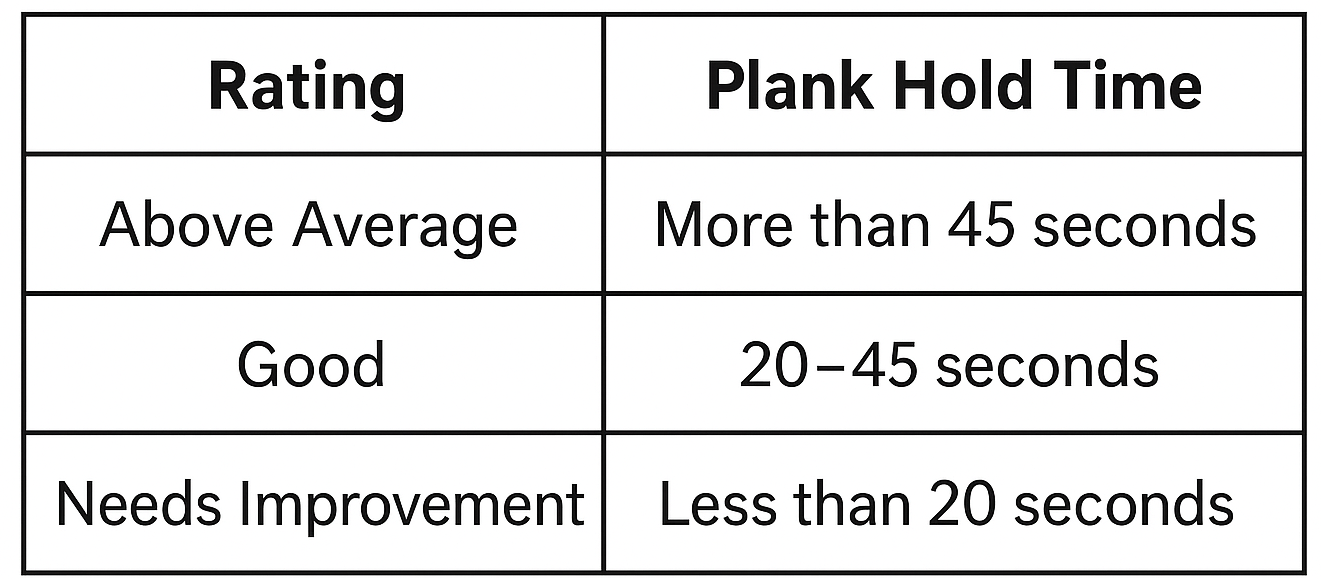
Timed Plank
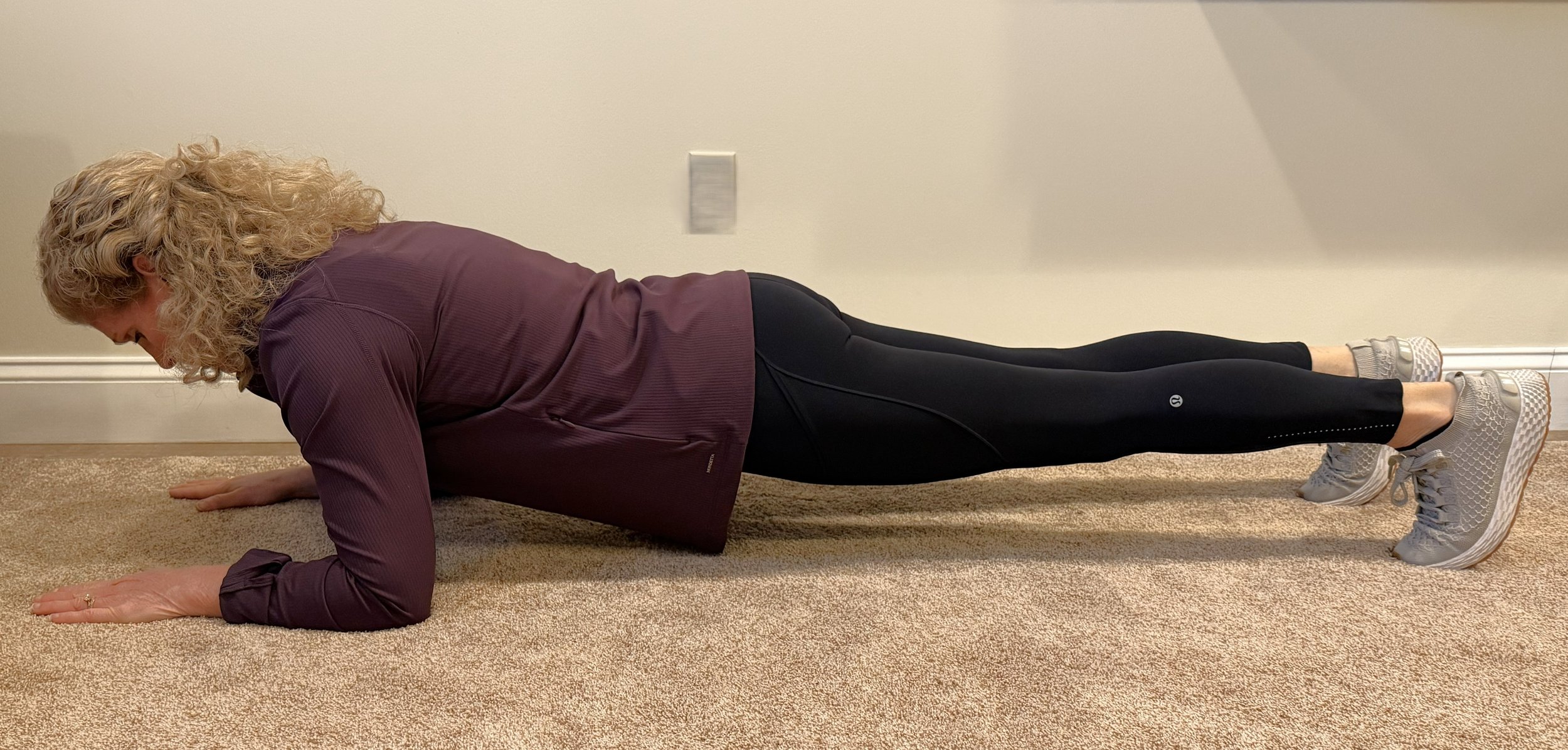
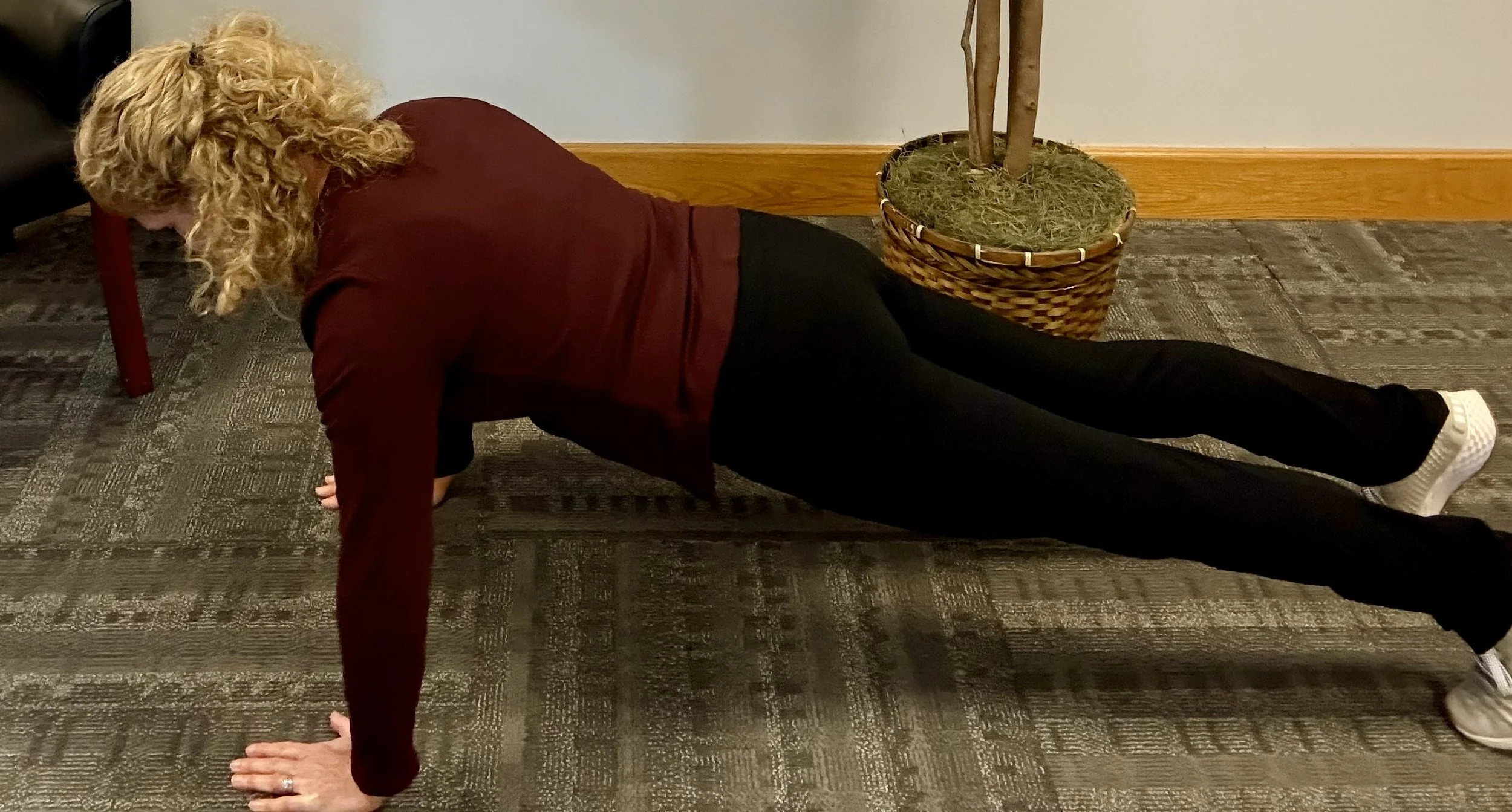
Lie on the floor with your elbows bent and directly under your shoulder, forearms are touching the ground or arms are straight and directly under the shoulders. Press up onto your toes keeping your whole body straight as a board and hold. Stop the test when you can no longer keep your body straight or with any movement such as swaying, sagging or bending at the back or hips. Hold for time.
Birddog
Begin on your hands and knees, with your hands directly under your shoulders, and knees under your hips. Raise your right arm and left leg and hold them out straight at the same time for a second or two. Then switch and raise your left arm and right leg. Alternate x10+.
Back Extension Hold
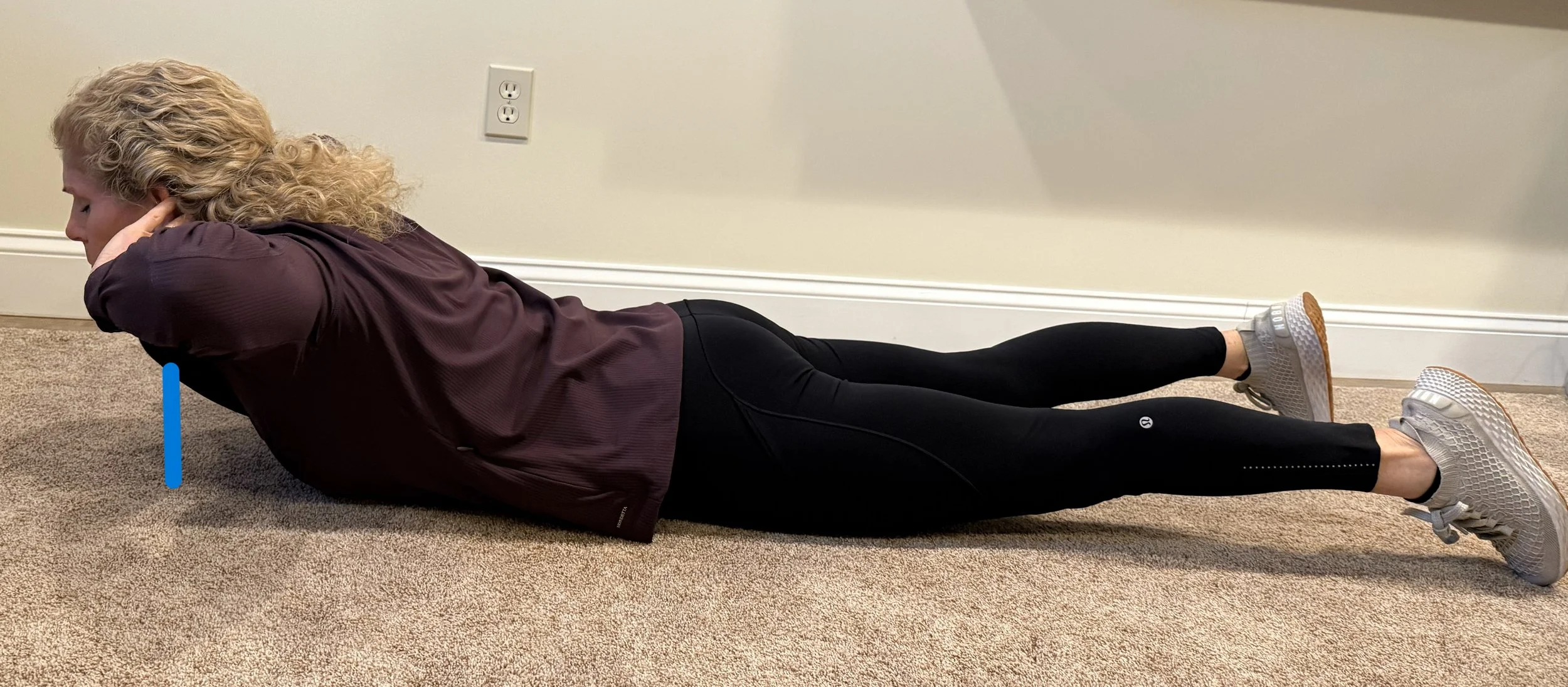
Lie on your stomach with your hands behind your head, raise your head, shoulders and chest off the floor. Hold at the top for time.
Rolling
Lie on your back with your arm overhead and legs straight, roll your body to the right onto your stomach without using your arms or legs to push off, then roll back to the left from your stomach onto your back. Repeat rolling your body to the left from your back onto your stomach and then return to lying on your back x1 per month.
Signs of a weak core:
Poor posture and alignment
Difficulty standing for longer periods of time
Noticeable torso or hip swaying during gait
Decrease coordination and balance especially when bending, reaching, and twisting
Difficulty with lifting and carrying objects
Chronic neck and back pain
Increase frequency of shoulder and hip pain and injury.
Unsteadiness with transitioning from sitting to standing
Less confidence with movement, increased fear of falling
Increase in falls
Difficulty or inability to roll or sit up in bed
Difficulty or inability to climb stairs or get up from the ground
Holding your breath when exercising or during strenuous activities
Inefficient and shallow breathing
Decreased bladder and bowel control
Core strength is essential for nearly every activity of daily living. A strong, well-coordinated core enhances how you move, feel, and function throughout your day.
Better Posture and Alignment
Strong core muscles help you sit and stand upright with less effort. They support the natural curves of your spine and keep your body in proper alignment, reducing strain on your joints. With less fatigue from poor posture, you will have more energy and feel more at ease with any sitting or standing activities.
More Efficient Movement
Your core acts as your body’s control center. Its primary job is to support your spine and serve as a stable base for all movement. When your core is strong, your torso and pelvis stay steady, allowing your arms and legs to move with greater power, precision, and coordination. This leads to smoother, more efficient motion in everything from walking and climbing stairs to completing household tasks and recreational activities.
Reduced Risk of Injury
A stable core acts like a built-in support system for your spine and joints. When the core is weak, it does not activate as quickly or fully when needed, causing your body to compensate with poor movement patterns. Over time, this can lead to overuse injuries, back pain, or strain in other areas of the body. A strong core helps distribute stress more evenly and allows proper force transfer during activities like bending, lifting, throwing, squatting, and jumping.
Improved Balance and Stability
Core strength plays a major role in balance, especially as you age. It is not just your feet and ankles that keep you steady. Your core muscles help stabilize your trunk and pelvis, and when these muscles are weak, your balance is significantly affected. Whether you are navigating uneven ground or reaching overhead, a strong core provides the control and confidence needed to stay steady and safe.
Easier Everyday Activities
Everyday movements such as getting out of bed, lifting groceries, bending to tie your shoes, depend on your core. Strengthening these muscles makes daily tasks easier, more comfortable, and less likely to cause strain. You will also feel less fatigued because your body is working efficiently rather than fighting against poor posture or weakness.
Internal Support and Efficient Breathing
Your core does more than support your skeleton, it also supports your internal organs. A strong core improves breathing mechanics, aids digestion, and can even improve circulation. The core muscles and diaphragm work together to create efficient breathing and maintain internal pressure for organ stability. When the core is weak, the diaphragm will need to contract to add stability. Holding your breath during exercise or strenuous activity is a sign of core weakness.
Pelvic Floor Health
Your core and pelvic floor function as a team. Strengthening your core can improve bladder and bowel control, support recovery after childbirth, and help prevent pelvic organ prolapse.
Having a strong core is one of the best investments you can make in your long-term health and confidence. A sturdy, responsive core helps you move with greater certainty and freedom. You begin to trust your body’s ability to support you, reducing fear of injury and helping you stay active and independent for years to come.
Rising from the floor
Start by lying on your back then stand up to your full height x1 every month.
During fall-history reviews, some of the most heartbreaking stories I hear come from individuals who have fallen and remained on the floor for hours or even days until someone found them. In many cases, the main obstacle was not an injury, but their inability to roll onto their side or stomach, which could have let them crawl or slide toward a phone or sturdy piece of furniture for help.
Falling is a frightening experience that can change someone both physically and emotionally. I have worked with many patients who suffered significant falls and through hard work, regained independent mobility.
However, once therapy ends, the fear of falling again can quickly take hold. Many people become hesitant to move around, especially when they are alone. Some even decide to stop walking altogether and rely on a wheelchair, despite still having the physical ability to stand and walk. For these individuals, the fear of falling outweighs the benefits of staying mobile.
Unfortunately, this choice can set off a cascade of decline. When you stop standing and walking, muscle strength, flexibility, and balance diminish quickly. This makes standing or walking even harder, which further increases fall risk and limits independence.
Relying solely on a wheelchair can also lead to social isolation. Without the ability to walk, everyday activities, grocery shopping, attending medical appointments, visiting friends and family, become far more challenging, especially if your home or your family and friends’ homes are not accessible. Without an able body to help with using stairs or public restrooms, a person’s world can shrink dramatically.
The COVID-19 pandemic reminded us how essential it is for our emotional well-being to have something to look forward to, somewhere to go, something to do, and people to see. No one wants to feel trapped in their own home.
Single Leg Stance
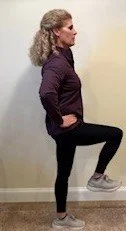
With your eyes open and hands on hips, stand on one leg by raising your other leg to the height of your waist. Start timing when your foot leaves the ground. Stop timing when your hands come off your hips, your legs touch or your raised foot touches the ground. Repeat with other leg.
Age-Specific Norms:
18-39 years: Average: 43 seconds
40-49 years: Average: 40 seconds
50-59 years: Average: 37 seconds
60-69 years: Average: 30 seconds
70-79 years: Average: 19 seconds
Over 80 years: Average: 5 seconds
Consider your daily routine: do you spend most of your time in stable positions such as sitting or lying down? If so, it is important to intentionally challenge your balance. Without regular practice, balance will decline over time.
Engaging in activities that require dynamic movement is one of the best ways to stay steady on your feet. Trail hiking, biking, kayaking, skiing, dancing, fitness classes, and most sports all stimulate the muscles and systems responsible for keeping you balanced.
You can also weave balance practice into everyday life. Try standing on one foot while brushing your teeth, waiting in line, doing laundry, washing dishes, or cooking, any simple activity where you can safely challenge your balance. If appropriate for you, make it a habit to stand while putting on your socks and shoes.
These small, intentional actions add up and can help you maintain and even improve your balance over time.
Single Heel Raises
** Please hold onto a sturdy surface when doing this activity to keep your balance.
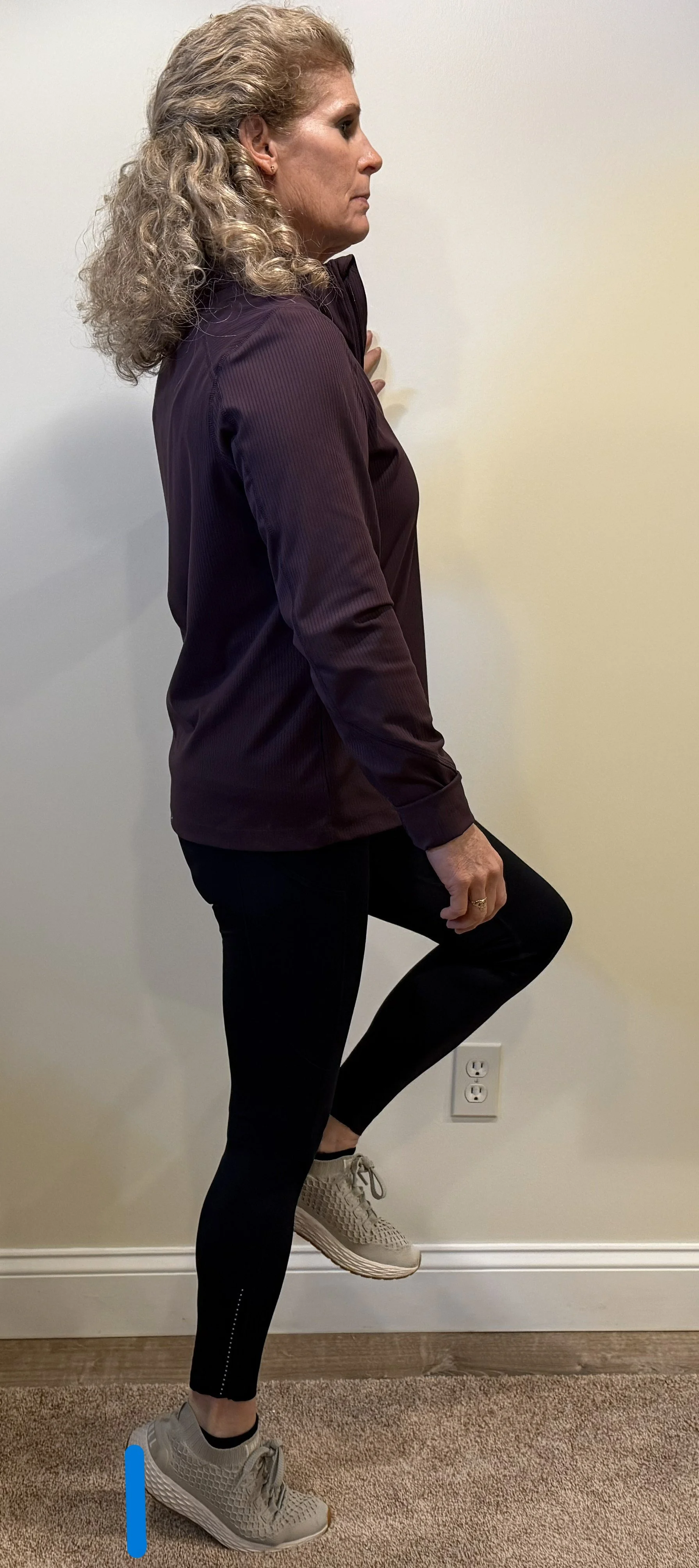
Stand on your right leg and raise onto your toes lifting your heel off the ground 25 times with no rest breaks, Repeat with left leg.
Many people strengthen their upper body, hips and buttock but forget to work their calves. Have you ever seen someone with a chiseled chest and sculpted abs but have the tiniest calf muscles?
Strong calf muscles are far more important than most people realize. They do more than help you walk; they play a key role in keeping you steady, mobile, healthy and self-reliant
Your gastrocnemius and soleus muscles store and release energy with every step, pushing you forward and upward allowing you to walk, run, climb stairs, and move more efficiently. They give you the power to stand on your toes to reach for something up high and to jump out of the way for safety.
Why Strong Calves Matter
Better balance and stability.
Your calves work together with the stabilizing muscles in your ankles to maintain alignment. This teamwork keeps you upright and steady, especially on uneven surfaces or when changing direction, reducing your risk of falling.Protection for your joints.
As your calf muscles become stronger, they can absorb more impact from the ground with each step, which helps ease the stress on your knees, hips, and lower back. They also help protect your ankles and feet by supporting proper movement mechanics, lowering the risk of sprains, shin splints, and tendon injuries.
Improved circulation.
Every time your calf muscles contract, they help pump blood back toward your heart. This “calf pump” reduces swelling, fatigue, and poor circulation in the lower legs.Greater independence after illness or injury.
Strong calves are essential for safely navigating stairs, something many people take for granted. After hospitalization or a rehabilitation stay, individuals often cannot return home until they demonstrate that they can safely manage the number of steps outside their residence. In some cases, discharge is delayed, or long-term placement is required simply due to inadequate lower leg strength. The more muscle reserve or strength you have prior to an illness or injury, the more you can afford to lose without risking your independence.Increased confidence and long-term mobility.
Strong lower legs help you move with certainty and ease. When you feel steady, you move more freely. You trust your body to support you, which reduces fear of injury and helps you stay active and independent for years to come.
Being active can increase your calf strength:
Many activities help build calf strength and are effective for toning your lower legs, including walking, hiking, and jogging, especially when going up hills, stairs, or steep inclines. The greater the incline, the harder your calf muscles must work. Dynamic exercises like jumping rope, skipping, and sports involving running, jumping, and pushing off also target the lower leg. Dance and aerobics, which require shifts in speed and direction, can collectively strengthen all the muscles in the lower leg. Swimming is another excellent low-impact option. Using fins will increase the engagement of your calves without placing excessive stress on your joints.
Strong calves support your mobility, balance, and independence. By incorporating calf-focused activities into your routine, you set yourself up for better movement and better health long-term.
Try these exercises to improve lower leg strength:
Seated Calf Raises – sit and lift your heels off the ground x20. Bonus – Alternate lifting heels then toes (to strengthen the tibialis anterior “shin” muscles) x20. Alternate lifting heels then toes, with feet pointing straight x20, then feet pointing outward (Duck feet \/) x20 and feet pointing inward (pigeon toes /\) x20 to work all the muscles around your lower leg. Progress - add weight onto your thighs.
Standing Calf Raises – stand with your legs hip width apart, lift your heels off the ground x20. Bonus – Alternate lifting heels then toes (to strengthen the tibialis anterior “shin” muscles) x20. Alternate lifting heels then toes, with feet pointing straight x20, then feet pointing outward (Duck feet \/) x20 and feet pointing inward (pigeon toes /\) x20 to work all the muscles around your lower leg. Progress – stand on one leg. Progress - hold dumbbell/kettlebell and/or wear a weighted vest.
Stair Calf Raises – stand with your legs hip width apart on the edge of a step with heels hanging off, lower heels below step, then raise onto your toes x10+. Bonus – Lift heels with feet pointing straight x10+, then feet pointing outward (Duck feet \/) x10+ and feet pointing inward (pigeon toes /\) x10+ to work all the muscles around your lower leg. Progress – stand on one leg. Progress - hold dumbbell/kettlebell in the hand of the working leg and/or wear a weighted vest.
Toe Walks – walk on your tiptoes for 20 seconds. Progress – walk up a hill or incline. Bonus – walk on your tiptoes for 20 seconds then walk on your heels for 20 seconds (to strengthen tibialis anterior “shin” muscles and improve balance). Progress – hold dumbbells/kettlebells and/or wear a weighted vest.
Author’s Note:
This list of corrective exercises is not exhaustive and should not replace those prescribed by your Health Care Professional. Please consult your Health Care Provider or a Physical Therapist for more individualized exercises and treatments tailored to your specific needs.
Keep visiting my website for more articles that inspire “aha” moments, offer tips to enhance your mobility, build strength, improve balance, prevent injuries and teach you how to reduce stiffness and pain so you can live your best and most active life.
If you have not taken my other two assessments, Posture & Alignment Assessment and Mobility & Flexibility Assessment I encourage you to do so. These evaluations will provide further insight into how your body maintains its posture and alignment, bends, and moves.